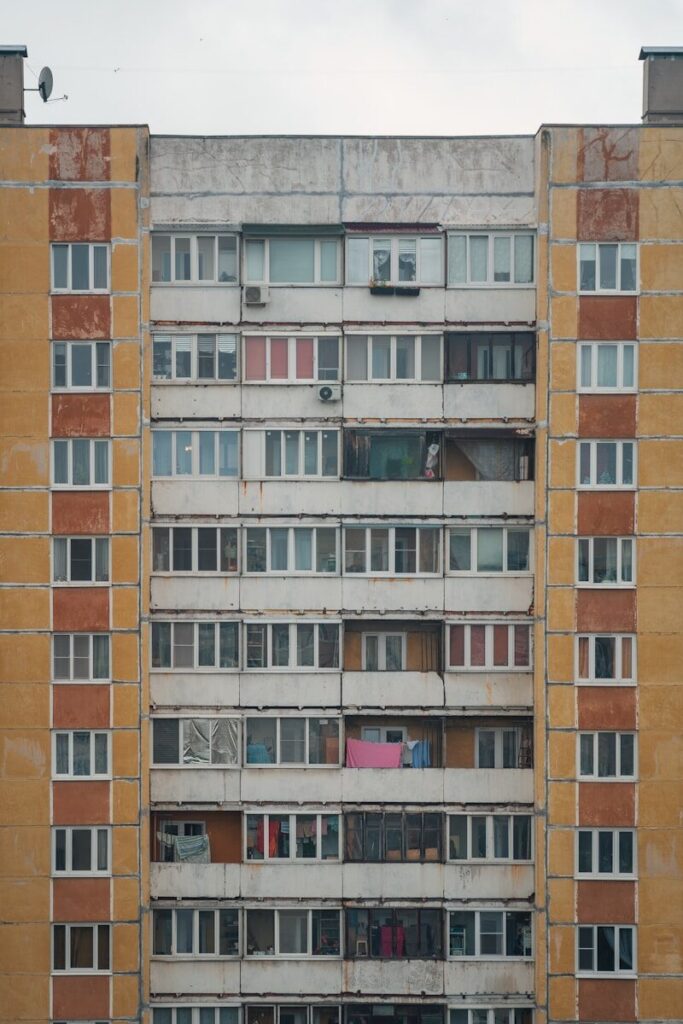
My first encounter with bricks and mortar came, as for most people, from my childhood. But the notion of what a house or an apartment means was not the same as for many people in developed countries. This is because most of my childhood and pre-teen years were spent in what is now the former USSR. While people had a place to live, it was not their own — because private property did not exist in Lithuania at that time.
Detached houses were extremely rare, apart from an allotment plot where people were allowed to grow their produce and build a small structure, which was generally not suitable for permanent habitation. The other group who had access to detached houses were the elite — and yes, it did exist even in Soviet times.
Most people lived in apartments, often in buildings of 6 to 12 storeys, with a small separate kitchen, one bathroom and bedrooms. If you were unlucky enough, you could end up living in a “komunalka”, or communal apartment. Don’t make a mistake — this was not the birth of modern communal living with shared facilities, a gym and a concierge. This was a cramped, dilapidated apartment where one room was occupied by a whole family, and the kitchen and bathroom could be shared by up to ten or more occupants. Quite often families living in those communal apartments were assigned there temporarily but ended up staying for years, waiting for a separate apartment to become available.
Housing needs and priorities were assessed based on family size, but housing was scarce and waiting times could last for decades. The right to live in an apartment was free — in essence this meant the occupant didn’t pay rent or a mortgage (a concept that didn’t even exist) but was required to pay utility bills and maintenance charges.
Because the concept of property ownership didn’t exist, property couldn’t be sold. Complications arose when people’s housing needs changed and they had to find a way to upgrade or downgrade their space. If a couple was divorcing, for example, they could exchange their apartment for two smaller ones — but one can imagine what a nightmare that was.
In 1991 life changed forever for Lithuanians, because the regime was overthrown and the nation finally celebrated its independence. However, the teething issues meant that the 1990s were years of poverty for some and opportunity for others. The change was overwhelming for those who couldn’t adapt to the new economic reality and embrace a capitalist world. Those who could, had the chance to obtain physical capital at low cost and build wealth.
Those who were lucky enough to be living in an apartment at the time were given the opportunity to buy the one they were living in. Special vouchers — essentially a form of currency — were issued by the new government, but quite often families still had to scrape together additional funds. Banking and credit did not develop overnight, and it took quite a few years before mortgages became available. Credit was a very murky territory for most.
The mental shift from owning outright to borrowing is still a challenging concept in former USSR countries. Even when property is bought using credit, the focus is often on repaying the loan as quickly as possible. But the new generation is now fully adapted to the new reality, and the approach to property is quite similar to anywhere else in Europe. And my childhood shaped the way I think about property — not just as an asset or an investment, but as something deeply tied to freedom, security and opportunity.